

Short answer: your villa is billed in US dollars, so most of the extra cost you see in Canadian dollars is simply what US dollars cost. The part you can control is the fees stacked on top, and a direct booking paid with a no-fee card (or US dollars you already hold) removes almost all of them. Prefer to pay in Canadian dollars? Ask us for a CAD payment link.
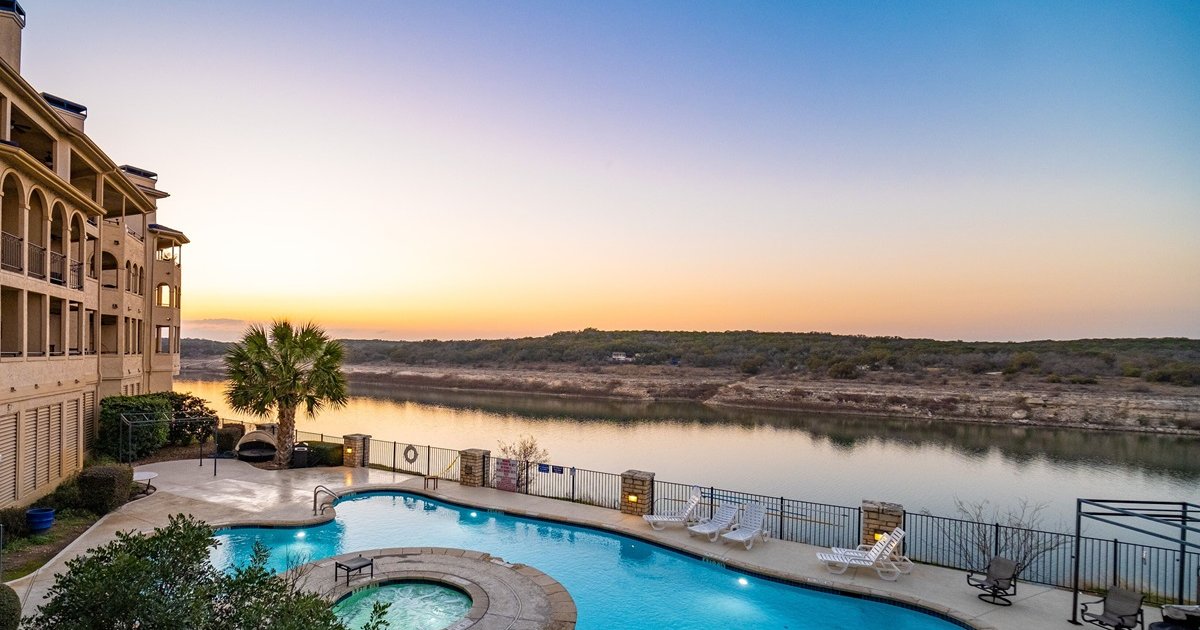
Plenty of the snowbirds who settle into our villas at The Island on Lake Travis each winter come from Canada, and the payment side is one of the first things they ask us about. Here is how it works and how to keep more of your winter budget for the marina, the pools and the Hill Country sunsets.
Where does the extra cost come from?
Think of it in layers:
- Layer one, the rate. At roughly C$1.38 per US dollar, every US$100 costs about C$138. This layer is the large one, and no one can make it go away.
- Layer two, your card. Most Canadian credit cards quietly add about 2.5% whenever you buy something priced in another currency.
- Layer three, the booking site. Both Airbnb and Vrbo take a cut. On top of that, Airbnb tacks up to 2% onto its guest service fee when you pay in a currency different from the listing’s.
Layers two and three are optional. Layer one is the market.
What does a three-month winter look like?
Here is a one-bedroom villa at US$2,100 a month, December through February, at a rate of 1.38 (taxes left out to keep the numbers clean):
| Three months, one-bedroom villa | US$ | About C$ |
|---|---|---|
| Villa rent | 6,300 | 8,694 |
| A typical 2.5% card fee | + 217 | |
| Airbnb’s extra cross-currency charge, up to 2% | + up to 174 | |
| Airbnb’s guest service fee, where the listing has one | + often more than both combined |
Booked direct and paid with a no-fee card, your cost is the first row.
Six ways Canadian guests keep more of their money
1. Book on our site, not a platform. A direct booking carries no platform service fee and no platform currency charge. You pay the villa rate, the fees listed on your quote and Texas lodging taxes. A monthly stay still comes with full resort access: pools, hot tubs, the marina, tennis courts and the shuttle. More on that in why booking direct pays off.
2. Carry a card that skips the foreign transaction fee. Only a few Canadian cards do. Scotiabank Passport Visa Infinite, Scotiabank Gold American Express and Home Trust Preferred Visa are the names that come up most. Some well-known travel cards keep the 2.5% fee and offset it with bonus cash back on US purchases, so run your own numbers. Over a full winter, a no-fee card typically saves more than its annual fee.
3. Spend US dollars you already have. If your Canadian bank offers a US dollar account or US dollar card, paying from it means no conversion at checkout. Many snowbirds convert a lump sum before the season, using their bank or a service like Wise, when the rate is in their favor.
4. Want to see Canadian dollars? Request a CAD payment link. Booking direct, you can ask us to send a secure link priced in Canadian dollars rather than having your card convert a US charge. You see the exact CAD figure before paying, and the rate is fixed at that moment. Expect a built-in conversion cost of roughly 2% to 4%, about what most Canadian cards charge anyway, so it buys certainty rather than savings.
5. Line up funds for each payment. A winter booking is usually split into a deposit and a later balance, and each one converts on the day it is charged. Ask us for the dates up front so you can move US dollars over, or simply make sure the card is ready, ahead of each charge.
6. Give your bank a heads-up. A large charge from a Texas resort is exactly the kind of thing fraud systems flag. A short call or app alert before you book, and again before you head south, keeps the card working when you need it.
What happens if money comes back to me?
A refund or returned deposit converts back into Canadian dollars at that day’s rate, and card issuers often use a slightly less favorable rate for refunds than for purchases. On top of that, many issuers don’t return the original 2.5% fee. Using a no-fee card from the start avoids most of that loss.
Common traps to skip
- Picking Canadian dollars at a platform’s checkout. The conversion still happens. You just let the platform set the rate, usually with a margin built in.
- Saying yes to “pay in your home currency” offers on a terminal or payment page when your card has no foreign fee. Your card’s own rate is almost always better.
- Blaming fees for the whole difference. To see what you really paid in fees, compare your statement’s rate with that day’s published rate, then add any line labeled as a foreign transaction fee.
Two border rules for long winter stays
Not about money, but they matter for anyone staying a month or more:
- The 30-day registration rule. Visitors to the US who stay 30 days or longer must be registered. An I-94 record issued at entry usually counts; travelers without one file a free online form. Confirm the current requirements on the USCIS website before you go.
- Counting your days. The IRS weighs your days south of the border across the current and two previous years, and too many can make you a US tax resident. Filing IRS Form 8840 each year is how many snowbirds stay clear of that. If you’re near the line, check with a cross-border tax professional.
Questions before you book?
North Shore Vacation Rentals manages villas at The Island on Lake Travis, about 40 minutes from Austin. A good share of our long winter stays are Canadian guests, and we’re glad to go through quotes, payment dates, a Canadian dollar payment link and anything else before you commit. Call our local team at (512) 267-4887.
When you’re ready to plan, start with our Winter Texan rates, then read Winter Texan Season at The Island and what The Island is like in winter.
Picture your winter on Lake Travis
Monthly villa rates, resort access and direct booking in US dollars, with a local team to answer payment questions first.
See Winter Texan Rates →